
The first 3 seconds are not a warm-up. They are the audition. The viewer is deciding whether your video deserves attention before your setup sentence is finished.
That is why hooks matter in short-form video. Not because hacks beat substance, but because substance needs a doorway. If the opening is vague, the useful part may never be seen.
Why the opening matters
TikTok’s creative guidance emphasizes hooks early in the video, and Google’s ABCD framework starts with attention. Different platforms phrase it differently, but the behavior is the same: viewers decide fast.
Five hook types that work
- Contradiction: “Your captions are not the reason your Reels fail.”
- Specific pain: “This is why your product demo loses buyers at second four.”
- Proof first: show the result before explaining the process.
- Teardown: “This viral ad works because of one edit.”
- Challenge: “Make this video understandable with sound off.”
Use AI to test hooks
Generate twenty openings for the same concept. Then kill the polite ones. Keep only the hooks that make the viewer instantly understand the conflict or payoff.
The hook checklist
- Can the viewer understand the topic in one frame?
- Does the first line create a reason to stay?
- Is the payoff implied early?
- Does the caption add meaning?
- Would the video still work muted?
Test three openings, not one
A hook is only a guess until three rival openings prove which guess was right.
In the first opening, rewrite the spoken line. In the second, replace the frame the viewer lands on. In the third, reorder when the payoff shows up. Tweaking a caption word or re-timing a transition by a beat is not a variant; the difference has to be big enough that a viewer would register it in three seconds.
Then read the signals that actually measure a hook:
- 2-second hold
- 6-second hold
- average watch time
- completion rate
- rewatches
- shares
- saves
- comments that echo your opening line or ask for the next part
- profile visits
- follows per view
A flop is rarely the algorithm turning on you. Far more often the first frame was unreadable, the opening line had no pull, the payoff lagged, or the hook answered a question nobody was holding.
Hook bank
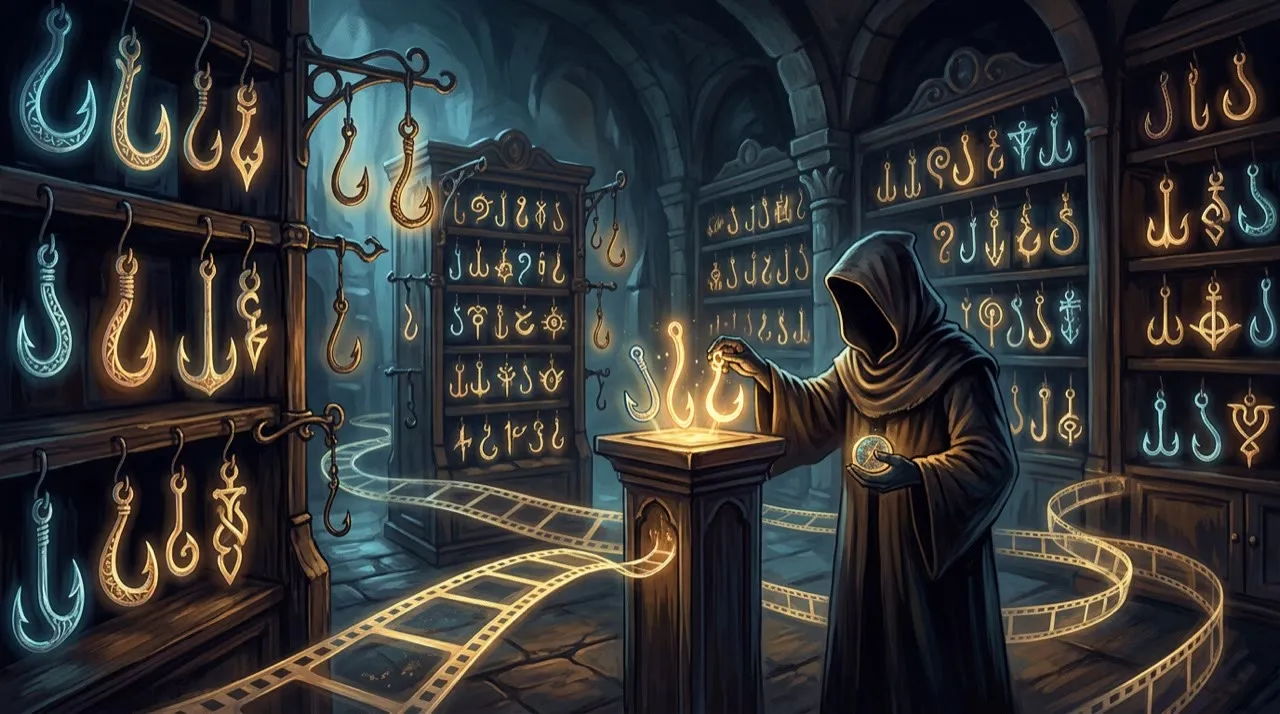
Treat these as molds and cast your own topic into the brackets:
- “The reason for [bad outcome] is not [what you assume]. It is [the thing you overlook].”
- “I spent a week on [thing] so you can skip straight to the verdict.”
- “Looks completely normal, right? It is exactly why [bad outcome] keeps happening.”
- “Put [popular tactic] on hold until you have fixed [the real bottleneck].”
- “Reach [desired result] without grinding through [the part nobody enjoys].”
- “Here is what no one bothers to tell newcomers about [topic].”
- “I was one click from buying [product/category] until I spotted [the catch].”
The hooks that land are not the loudest ones. They are the sharpest ones.
A practical first 3 seconds workflow
Start with one opening, not a whole video. Not a vague “make it more engaging.” One first frame and one first line.
Name the exact viewer who should stop scrolling, the tension the opening will create, and the payoff that tension promises. Then write three different first lines and pick the first visual that proves the topic in a single frame. Render those three openings only after you know what the hook is pointing at. Cut the strongest one, then make two real variants that change the line or the visual, not the caption wording. Post all three, watch the 2-second hold, and rebuild the winner with an even sharper first frame.
That is the hook loop:
- Viewer
- Tension
- Payoff
- First line
- First frame
- Generate openings
- Cut the winner
- Variant
- Publish
- Measure the 2-second hold
Most openings fail because the creator films or renders the first three seconds before deciding what question they should plant. Lock the tension and the payoff first, then build the frame and the line to point straight at them.
The pre-publish hook check
Before publishing, judge the first three seconds against five questions:
- Is the topic obvious in the first frame, even with the sound off?
- Does the first line create tension, curiosity, or recognition instead of just announcing the subject?
- Is the payoff implied early enough that staying feels worth it?
- Does the hook actually match what the video delivers, so the viewer never feels tricked?
- Is the opening tuned to the platform it is built for, not a generic edit?
Fall short on any of them and a clean export earns nothing; hold it back. AI can spin up twenty openings in seconds. It cannot tell which one earns the next three seconds of attention.
Rewrite weak hooks into strong hooks
A weak opening narrates the subject. A strong opening hands the viewer a reason to lean in.
Weak:
“Let me walk you through better video habits.”
Better:
“The first frame is where your video loses everyone. Watch.”
Weak:
“Here is an overview of AI video software.”
Better:
“Most people run this AI video step backward, and it shows in second one.”
Weak:
“A marketing idea for local gyms.”
Better:
“Your gym’s best transformation never makes it into the first three seconds.”
The lever is specificity. The strong version names a pain the viewer recognizes on contact.
First-frame checklist
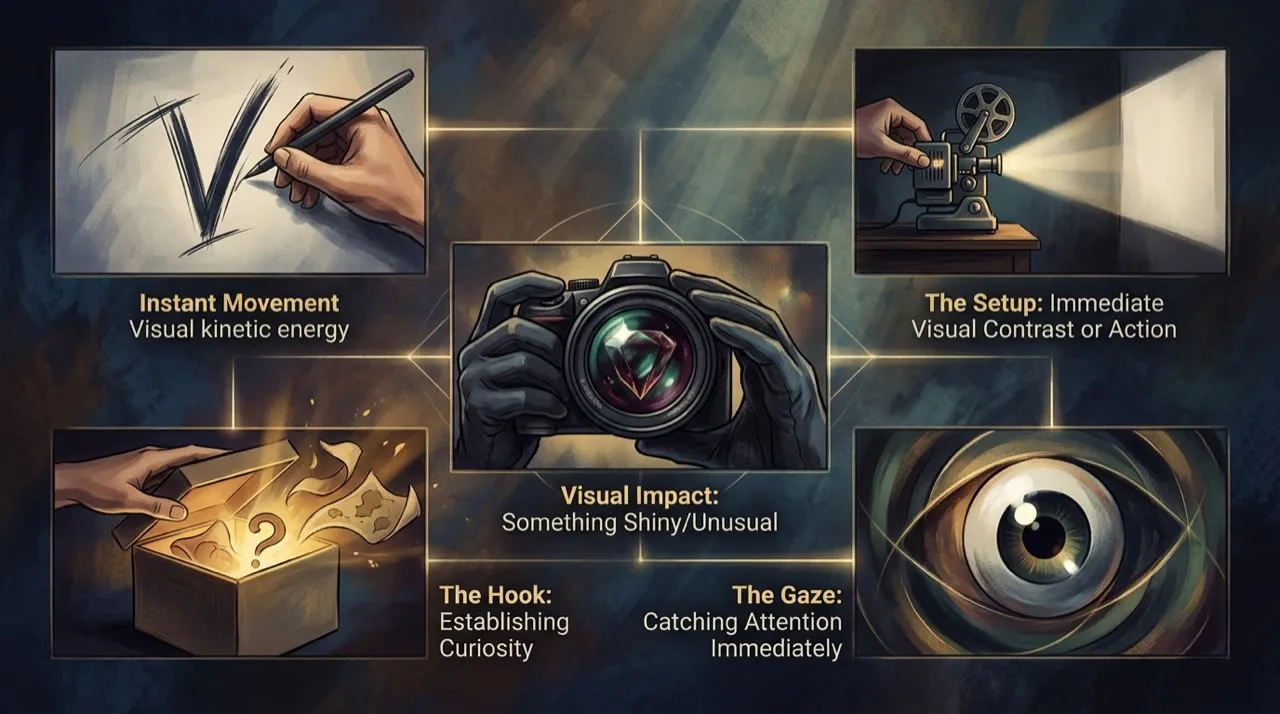
Hold the playhead on frame one and put it on trial:
- Is the subject of the video legible from this single frame?
- Is a face, an object, an outcome, or a visible conflict already on screen?
- Could you read the overlay text at arm’s length on a phone?
- Does the subject sit clear of the UI clutter at the edges and bottom?
- Would someone who has zero loyalty to the account give it the next second?
Where the answer is no, the first frame is broken, and that comes before any other edit.
Final pre-publish checklist
Before the video goes live, run one last pass on the opening that is harsher than the take you fell in love with.
Check the hook against what the video actually delivers. If the first line promises a fix, the payoff has to arrive and be specific. If it promises a teardown, the edit you call out has to be on screen. If it implies a result, the before/after or the dashboard has to show up in the first few seconds, not buried at the end. A hook that overpromises reads as a trick the moment the payoff lands soft.
Then watch the opening with the sound off. The topic should be obvious from the first frame alone, the on-screen text should be readable on a phone, and the subject should sit clear of the platform UI. If you need the audio to understand what this is, the muted scroller is gone before your first word.
Finally, check the stakes. Read the first line out loud and ask whether it makes a real viewer feel a specific tension, curiosity, or recognition, or whether it just announces the subject. If the opening only describes the video instead of giving someone a reason to stay, rewrite it before you publish.
A 10-minute hook workshop
Take one video idea and write ten hooks. Force each one into a different structure:
- contradiction
- mistake
- test
- proof
- confession
- teardown
- before/after
- warning
- shortcut
- unpopular opinion
Now delete the five that sound like content marketing. Keep the three that make the viewer feel a specific tension. Record or generate those three openings and test them as separate drafts.
This is the work most creators avoid. They want the algorithm to reward the first version. It usually will not. The first version is just the raw material for the better version.
One last practical note
Stop holding out for the flawless concept. Lock one specific audience, one promise you can keep, and one format. Keep the first attempt small enough that you actually ship it. Let the second attempt be shaped by what real viewers did with the first.
That is the trade AI offers: it shortens the trip from a hunch to hard evidence. Take it.
The cut line
A video with no obvious viewer, no payoff you can point to, and no reason to be seen right now is not finished, no matter how clean the render looks. Make fewer openings. Make sharper calls about which ones deserve to exist.
It is a strict bar, and that is the point: it stops the channel from sliding into interchangeable AI filler.
The hook has to match the payoff
A strong hook creates a question the video actually answers. “This mistake is killing your Reels” can work if the mistake is specific and the payoff is useful. If the answer is obvious, the viewer feels tricked.
Write the hook after you know the payoff. Then cut every word that delays understanding. Show the visual proof early: the before/after, the failed attempt, the result, the surprising object, the dashboard, the product in use. The opening should make the viewer understand both the topic and the reason to keep watching.
Where it fits in the hook workflow
Hook testing comes down to shipping several versions of the same opening quickly, and that is the gap Vivideo fills. One prompt can generate a spread of hook options; the agentic AI chat can build out the fuller cut once an opening proves itself; manual mode lets you nail the exact first frame by hand. Brand kits and templates hold the look steady from version to version, and with AI voices plus 100+ avatars you can rewrite the first line or change presenters without booking another shoot.
The first 3 seconds: a hook teardown method
To improve hooks, stop asking whether the opening is “good.” Break it apart.
A strong first three seconds usually does at least two of these jobs:
- Names the audience
- Shows the problem visually
- Creates a curiosity gap
- Challenges a belief
- Shows a result first
- Starts in motion
- Makes the topic understandable without sound
Take a weak opener like “Here are three tips for better videos.” It has no audience, no tension, and no visual reason to stay. Now sharpen it: “Your video loses people before tip one.” That creates stakes. Sharpen it again with a visual: show a retention graph dropping at second two. Now the hook has proof.
AI can help generate hook variations, but it cannot decide which one has the cleanest tension. Read each hook aloud. If it sounds like a blog title, cut it. If it makes the viewer ask “Why?” or “How?” without feeling tricked, you may have something worth testing.
Conclusion
The first three seconds only carry their weight when they are aimed at a specific viewer, doing a specific job, on the platform you are actually posting to. AI will write you an opening line the moment you ask, but only you know the single promise this particular viewer has been waiting to hear.
Use the hook method in this guide as a filter: name the viewer, decide the tension, make the topic obvious in the first frame, match the opening to the payoff, and test the 2-second hold across real variants. That is how AI becomes a way to find a better opening faster instead of a way to mass-produce soft ones.
If you want one place to spin up a dozen hook variants, build the fuller cut once an opening proves out, and swap the first line across avatars and voices without reshooting, try Vivideo at vivideo.ai.