Video SEO is not just uploading a video and hoping YouTube or Google figures it out. Search engines need signals. Viewers need satisfaction. Those two things are connected.
AI video SEO means using AI to plan, structure, title, caption, repurpose, and improve videos so they can be discovered and watched. It does not mean stuffing keywords into a robotic script. Bad videos do not rank better because they said the keyword twelve times.
Start with the searcher problem, not the AI tool
The lazy version is asking AI for “a video about my topic” and uploading the first render. That gives you generic visuals, flat narration, and a retention drop in the first ten seconds — which YouTube reads as a result that did not match what the searcher typed.
The useful version starts with the exact query and the viewer behind it. What are they searching to understand, buy, avoid, or compare, and what does the current top result fail to give them? Once that intent is fixed, AI can help you write openings that answer faster, storyboard scenes around the sub-questions, generate B-roll, create voiceovers, and export query-aligned variants for both YouTube and Google Search.
Write the brief before you generate
Before you generate a single scene, pin down the query you want to rank for and the search intent behind it. A video built to "cover the topic" rarely ranks, because YouTube and Google both reward videos that satisfy one specific question better than the competing results already on page one.
- Query: what exact search are you targeting, and is it informational, comparison, or how-to intent?
- Promise: what does the viewer get to understand, decide, or do that the current top results fail to deliver?
- Proof: what on-screen demo, screen-record, data point, or before/after makes the answer credible enough to earn the watch time?
- Format: does this query want a Short, a step-by-step tutorial, a comparison with a verdict, or a long-form explainer with chapters?
Make the first line earn attention
YouTube and Google Search viewers do not owe you patience. TikTok’s creative playbook tells creators to put the hook in the first few seconds, and now that YouTube Shorts allows clips up to three minutes, the structure matters more, not less: a longer Short still has to prove in its first frames that it answers the query, or the retention curve collapses before the algorithm ever sees a reason to surface it.
A useful AI prompt for ranking work should force the model to open with the answer the searcher came for, not a slow runway toward it. Cut “Today I’m going to…” and “In this video…” — retention drops in those seconds are exactly the signal YouTube reads as "this result did not match the query."
Write 12 hooks for a YouTube and Google Search video about AI video SEO. Each hook must create curiosity in under 12 words, avoid clickbait, and make the viewer understand the topic without sound.Storyboard before you generate scenes
A storyboard is what keeps a ranking video on-query instead of wandering. It turns the search intent into an ordered sequence of shots — generated, filmed, screen-recorded, or built with avatars — that each move the viewer closer to the answer instead of padding watch time with filler that tanks retention.
For a Short targeting a single query, five to seven shots usually carry it: answer up front, context, proof, demonstration, payoff, and a close that points to the next asset. For longer explainers, map the shots to chapters that mirror the sub-questions a searcher would ask next, because those chapter markers are exactly what Google surfaces as key moments.
Edit for retention, not decoration

Good AI footage still ranks poorly if the edit bleeds watch time. On YouTube the retention curve is a ranking input, so cut the setup, make captions carry meaning for the many viewers who watch muted, and keep the first frame legible without sound. Do not hold back the answer the searcher came for unless the format itself is built on suspense.
A blunt way to predict the retention curve before you publish: watch the cut muted, then watch it while looking away from the screen. If the video stops answering the query in either pass, the dips that follow will read to YouTube as a result that did not match intent.
Measure versions, not vibes
Ranking for a query is rarely settled by one upload. Generate genuinely different attempts at the same search intent, not cosmetic tweaks — change the opening answer, the first visual, the length, the proof format, and the title framing. Then compare the signals that actually move ranking: click-through on impressions, average view duration, the retention curve, saves, and the comments that show the question was answered.
The point of AI here is the speed to test more query-aligned angles per week, not to flood the feed with near-identical clips that compete with each other for the same impressions.
YouTube SEO and Google video SEO are not the same
YouTube ranking is heavily shaped by viewer behavior: click-through, retention, satisfaction, and engagement. Google video visibility depends more on crawlability, structured data, page context, thumbnails, transcripts, and key moments.
A video can perform well on YouTube and still be poorly represented on Google if the page around it is weak.
AI video SEO checklist
- Write a human title around search intent.
- Create a thumbnail that shows the payoff.
- Add a transcript or clean captions.
- Use chapters for longer videos.
- Embed videos on relevant pages.
- Use VideoObject structured data where appropriate.
- Answer one primary search intent per video.
- Do not let AI generate unsupported claims.
Package the upload so search systems can read it
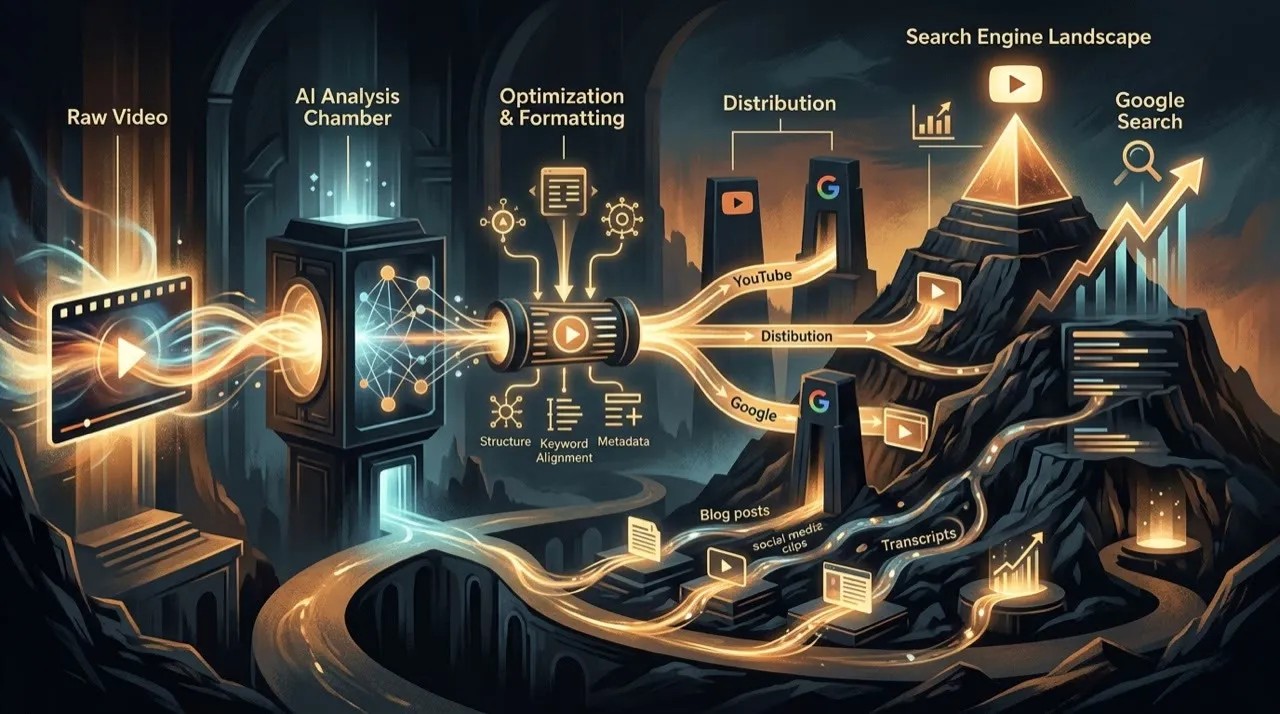
Ranking does not start when you publish the file — it starts with the metadata wrapped around it. Both search engines and viewers need that packaging to understand what the video answers, and a Short needs a different envelope than a long-form result.
For a Short, set up:
- a first frame that signals the answer with no sound
- a title that states the payoff in searchable language
- captions broken into lines that read at a glance
- a pinned comment that carries the next step
- a link to a long-form result or playlist for the same intent
- the AI disclosure label where the clip is realistic or altered
For a long-form result, set up:
- a title built directly on the query and its intent
- a thumbnail that previews the result or the conflict
- a description front-loading the value, with links and sources
- chapters that map to the sub-questions Google surfaces as key moments
- an accurate transcript, since search reads it where it can't watch
- a clear next video to keep the session going
AI can draft titles, descriptions, and chapter labels, but a fabricated timestamp or source doesn't just embarrass you — it spreads a false signal across every page that indexes the video. The packaging is part of what ranks, not an afterthought.
Read the signals that actually move ranking
View count is the weakest signal on the list. Watch the first-hour response, average view duration, where the retention curve dips, click-through on impressions, saves, the comments that confirm the query got answered, and the clicks onward to the next result.
For a Short, a clip with fewer views but strong replays and follows tells the algorithm more than a viral spike that satisfies no search. For a long-form result, holding retention and climbing in search impressions matters far more than one burst from a social share that never repeats.
You are not chasing a single ranking video. You are building a feedback loop that shows you which opening, length, and proof YouTube and Google reward for a given query — so the next upload targets intent more precisely than the last.
A practical AI video SEO workflow
Start with one query. Not ten keywords. Not a vague “grow the channel.” One search you want to outrank the current top results for.
Write the query, the intent behind it, the promise, and the proof. Then check the videos already ranking for it, create three openings that answer faster than they do, and build one storyboard. Generate the assets only after the storyboard is clear. Cut the first version for retention, then make two variants that attack the same intent differently. Publish, watch the retention and CTR, and remake the strongest version with a sharper opening.
That is the ranking loop, end to end:
- The query you want to win
- The intent behind that search
- An opening that promises the answer
- A scene map that delivers it
- Render the footage
- Edit for watch-time, not polish
- A swapped title-and-thumbnail test
- Publish, then package the metadata
- Measure click-through and retention
- Rebuild the video that ranked
Most videos rank poorly because the creator picks a query and starts generating in the same breath. Decide the search intent and the proof first, then generate, or you will optimize a video that never deserved the click in the first place.
The pre-publish SEO check

Before you hit publish, run the video and its packaging against these questions:
- Does the title and first frame match the search intent you are targeting?
- Are the captions or transcript accurate, not just auto-generated noise?
- Does the opening answer or tease the query fast enough to hold retention?
- Is the surrounding page (description, embed, structured data) ready for Google, not just YouTube?
- If the video is realistic AI-generated or meaningfully altered, is it disclosed?
A finished render that fails any of these is not ready to upload, no matter how clean it looks. AI can produce and package faster, but speed never makes a video rank for a query it does not actually answer.
Optimize before you edit
SEO starts before production. Choose the query, search intent, video promise, and structure before generating visuals. If the viewer wants a tutorial, give steps. If they want a comparison, give criteria and a verdict. If they want a definition, answer fast and then expand.
Use AI to create outlines, title variations, chapters, descriptions, captions, and FAQ sections. But check search results yourself. The top videos often reveal what viewers expect: length, depth, examples, thumbnails, and the questions left unanswered.
Where Vivideo fits in a video SEO workflow
For ranking work, the bottleneck is usually producing enough search-aligned variants to test without burning a week per upload. Vivideo helps here: use the agentic AI chat to plan a video around a specific query, one-prompt generation to spin up alternate hooks and angles for the same intent, and manual mode when you need exact control over a thumbnail frame or chapter beat. AI voices, templates, and brand kits keep the variants consistent, and API/CLI/MCP access lets you generate and repurpose at the cadence YouTube and Google testing actually demand.
AI video SEO: make the video understandable to humans and search systems
Video SEO starts before upload. Search systems need context, and viewers need a reason to click and keep watching. That means the video should have a clear topic, a useful title, a concise description, accurate captions, and supporting text on the page where it is embedded.
For YouTube, write titles around the viewer’s actual query, not clever branding. Use the first lines of the description to summarize the value, then add chapters, links, and related resources. For Google visibility, embed the video on a relevant page, add surrounding copy, use a descriptive thumbnail, and provide structured data where appropriate.
AI can help generate transcripts, descriptions, chapters, repurposed blog sections, and title variants. But do not let it invent timestamps, claims, or sources. If the transcript says something false, search optimization only spreads the problem further.
The best AI video SEO habit is simple: after generating a video, create a search-friendly companion asset. A useful page, transcript, or summary gives both users and search engines more to work with.
Conclusion
Video ranks when it answers the exact query a searcher typed and keeps them watching long enough to prove it. AI can clear the production bottleneck, but it cannot pick the query worth ranking for or judge whether your answer actually deserves the watch time.
Run every video through this ranking filter: name the query and its intent, lead with the answer searchers came for, build the watch-time edit so the retention curve holds, never let AI invent claims or timestamps, and package the page so Google can read it too. That is how AI becomes ranking leverage instead of more results nobody finishes.
If you want one place to plan a video around a query, generate alternate hooks for the same intent, voice and brand the variants, and refine the winner, start free at vivideo.ai.